Imagine training for a career, returning home ready to work, and finding that employers do not want you because you are a woman.
That was the barrier Kiran Mazumdar-Shaw faced after studying brewing in Australia. She wanted to follow her father into the brewing industry. Instead, she redirected her knowledge of fermentation towards a business of her own.
In 1978, at 25, she started Biocon in a garage in Bengaluru. The story is often reduced to a familiar headline: a woman with Rs 10,000 built a biotech company. But the useful part is what happened between those two points.
A blocked career was not a useless education
Mazumdar-Shaw had studied zoology and then trained in malting and brewing. Brewing depends on fermentation: using microorganisms to transform raw materials into something valuable.
When the brewing industry would not give her a fair opening, that knowledge still had another use. She formed a joint venture with an Irish company and began producing industrial enzymes. WIPO's account describes early products such as papain, extracted from papaya and used to prevent chilled beer from turning hazy.
She did not begin with a giant pharmaceutical factory. She began with a skill, an industrial application and a buyer who needed the output.
The Rs 10,000 headline misses an important detail
In a 2023 interview reported by Business Today, Mazumdar-Shaw recalled having Rs 10,000 in her bank account and no business experience. Bankers saw a young woman building an unfamiliar biotech business as a high-risk borrower.
But Rs 10,000 was not the entire financing story. She also described a buyback guarantee from her Irish partner and an advance payment of 10,000 British pounds for the enzymes she would produce. Even with that commercial backing, securing a credit line was difficult.
Eventually, a Canara Bank banker agreed to help. The distinction matters: a founder's small personal balance is not the same as the total resources supporting the company. Customers, partners, advances and credit can all play a role.
Building a team before the brand was famous
Hiring was another obstacle. In the same interview, she said people were reluctant to work for a woman. Her first two employees were retired tractor mechanics who needed work.
Later, students approached her for enzymes and career advice. Some joined the company. Public recognition also helped bring young engineers and other professionals into the team.
There is no neat overnight transformation here. Early credibility came from doing the work, finding people willing to participate and steadily attracting stronger talent.
From enzymes to medicines
Biocon's next stage was not simply selling more of the same product. It developed fermentation technology that helped it move from industrial enzymes into biopharmaceuticals.
WIPO's 2005 profile describes its PlaFractor technology: a system that brought cultivation and extraction processes into an enclosed, controlled environment. The technology helped open new research opportunities, including immunosuppressants.
That is the deeper founder story. Existing technical knowledge became a platform for entering a more demanding market. Biocon's current profile identifies Mazumdar-Shaw as its executive chairperson and describes affordable access to medicines as a central purpose.
5 lessons for young founders
- Change the market, not necessarily the skill. If one industry closes its doors, ask where else your knowledge solves a problem. Brewing expertise became the foundation for an enzyme business.
- Find evidence of demand. A customer's willingness to buy is more useful than applause for an idea. The buyback arrangement and advance gave the early business commercial backing.
- Understand your financing honestly. Do not copy a small-starting-capital headline without asking about customer advances, borrowing and partners. Plan for the full cash requirement.
- Build credibility through execution. A young company may not attract its ideal team immediately. Start responsibly with people who can help deliver, then create reasons for stronger talent to join.
- Turn expertise into an advantage. A distinctive process, documented know-how or useful intellectual property can make a business harder to copy. Research and protect it where appropriate, rather than relying only on promotion.
Not every garage business becomes Biocon. Her journey is not a promise of easy success. It is a reminder that rejection does not erase your skills, and a modest first operation can become a serious company when learning, customers and capable people grow together.
Sources
- WIPO Magazine: Building Biotech in Bangalore (2005 historical profile).
- Business Today: Mazumdar-Shaw's account of early financing and hiring (2023).
- Biocon: Kiran Mazumdar-Shaw's official profile.
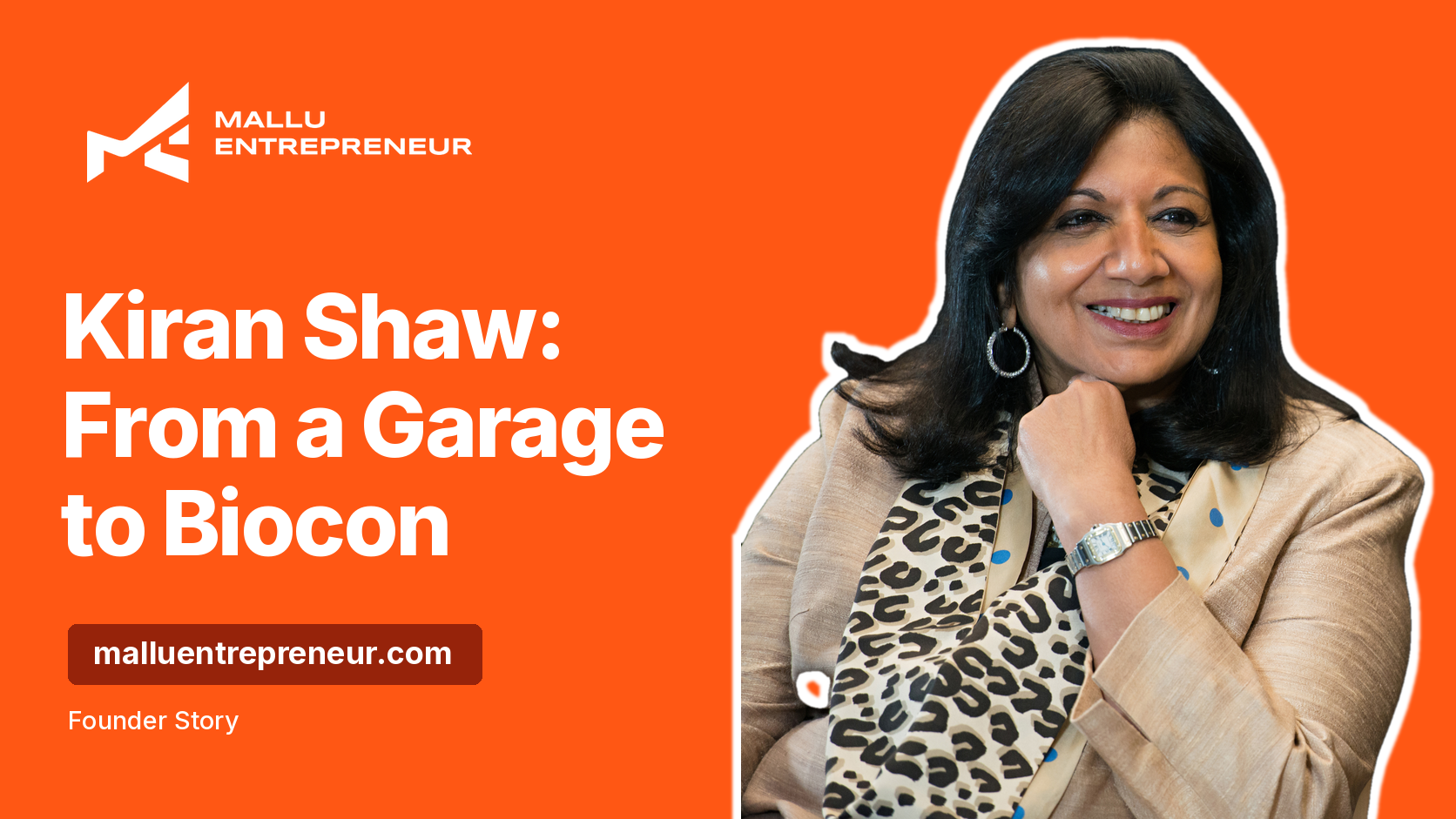
Banner photo: Sofia Negron / Science History Institute, via Wikimedia Commons, CC BY-SA 3.0. Cropped, background removed and placed in a banner. The adapted banner is shared under CC BY-SA 3.0.