 MALLU
SIP vs RD vs PPF: Where Should Your First Rs 5,000 a Month Go? (After the RBI Rate Hike)
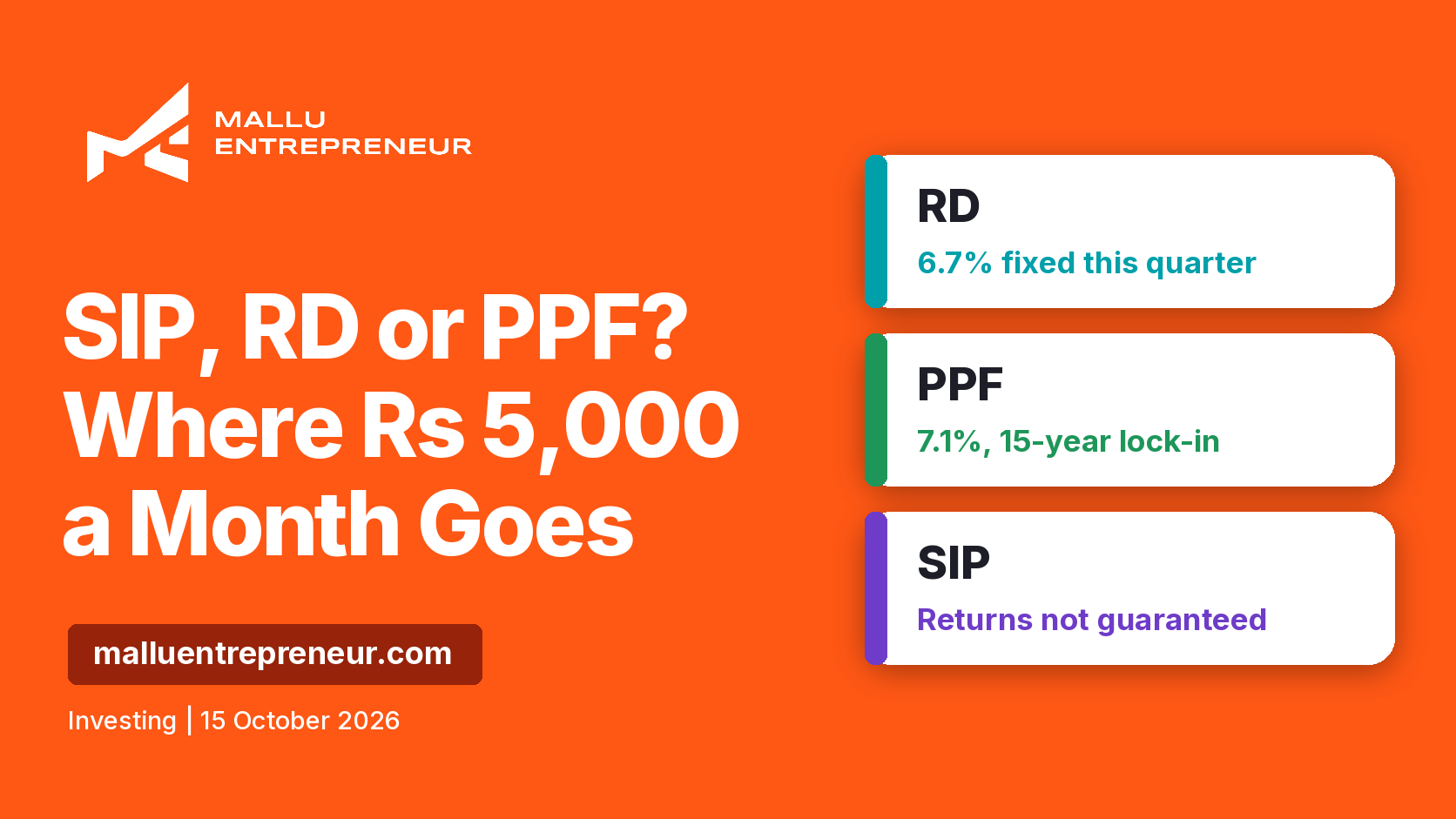
On 7 October 2026 the RBI raised the repo rate by 25 basis points to 5.50%, its first hike since February 2023, and said rate cuts are off the table for now. If you are about to start saving Rs 5,000 a month, you may wonder whether to pick a safe fixed-rate option or a mutual fund SIP. This guide compares a Post Office recurring deposit (RD), the PPF and an equity mutual fund SIP, using official rates and plain arithmetic.
What the RBI did and what it may mean for you
The RBI's Monetary Policy Committee voted unanimously on 7 October to raise the policy repo rate to 5.50% and changed its stance to "calibrated tightening". It also projected CPI inflation of 5.2% for 2026-27. Higher policy rates can, over time, push bank deposit rates up, but banks decide their own rates and timing. Small savings rates like the Post Office RD and PPF are set by the Finance Ministry each quarter. For October to December 2026, the ministry kept them unchanged from the July to September quarter. Inflation matters too. A fixed rate that is below inflation loses buying power in real terms. That is one reason people use more than one option.
Option 1: Post Office recurring deposit
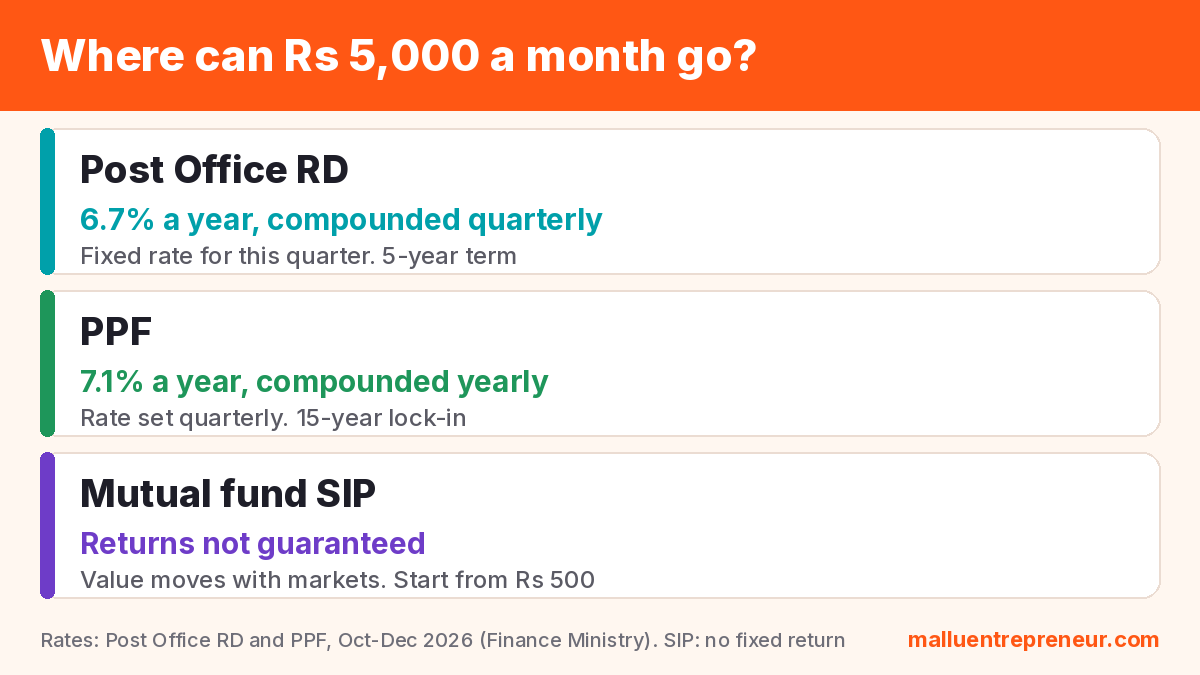
- Rate: 6.7% a year for the 5-year RD, compounded quarterly, for October to December 2026.
- You deposit a fixed amount every month and the rate is fixed at the time you open it.
- Money put in over 5 years: Rs 3,00,000. At 6.7% it grows to roughly Rs 3.57 lakh (my approximation with quarterly compounding, the post office statement is what counts).
- Good for: a goal you can name, such as an emergency fund, a fee, or a down payment, where you do not want a loss.
Option 2: Public Provident Fund (PPF)
- Rate: 7.1% a year, compounded yearly, for October to December 2026. The rate is reviewed every quarter, so it can change.
- Lock-in: 15 years, with limited early withdrawal rules.
- Rs 5,000 a month for 15 years is Rs 9,00,000 put in. At a constant 7.1% that would grow to about Rs 16.3 lakh (my approximation, the actual figure depends on when you deposit and on rate changes).
- Good for: long-term goals such as retirement, if you can leave the money alone. PPF is a government-backed small savings scheme.
Option 3: Mutual fund SIP
- A SIP is a monthly investment in a mutual fund. You can start with as little as Rs 500 on many platforms.
- Returns are not guaranteed. SEBI's and AMFI's investor guidance say mutual fund investments are subject to market risk and past performance is no guarantee.
- AMFI data released on 12 October showed record SIP inflows of Rs 32,490 crore in September 2026, up from Rs 32,297 crore in August, as reported by NDTV Profit. That shows how many people use SIPs. It does not mean your SIP will earn a particular return.
- Good for: long goals of 5 years or more, if you can stay invested through falls and do not need the money soon.
The same Rs 5,000 a month, five years: an illustration
Put in: Rs 3,00,000 over 60 months.
- RD at 6.7%: about Rs 3.57 lakh.
- SIP at an assumed 6% a year: about Rs 3.49 lakh.
- SIP at an assumed 10% a year: about Rs 3.86 lakh.
- SIP if markets are flat or fall: it could be Rs 3.00 lakh or less.
The SIP numbers are assumed flat rates to show the range, not forecasts. Real returns move up and down and can be below what you put in, especially over short periods. Over five years, an RD gives a known result. A SIP gives a range.

How to choose
- Write the goal and the date. Under about 3 years, a fixed option like an RD usually fits better than equity.
- Keep an emergency fund first, enough for several months of expenses, in a safe place.
- For goals 5 years or more away, consider a SIP for part of the money, and understand the risk before you start.
- For very long goals, PPF gives a government-backed base, but you must accept the lock-in.
- Split if you like. For example, part to RD or PPF and part to a SIP. The mix depends on your goal, income and comfort with falls.
- Recheck rates each quarter. The Post Office and PPF rates are announced by the Finance Ministry every quarter.
Common mistakes
- Picking a SIP for a goal that is only a year or two away.
- Choosing by last year's return. Past returns do not predict the future.
- Forgetting that interest on deposits may be taxable. Check your tax position or ask a tax professional.
- Stopping a SIP the moment markets fall.
Bottom line
There is no single best option. An RD gives a fixed, known result for short goals. PPF suits long, locked-in saving. A SIP can suit long goals if you accept that its value moves with markets. With the RBI now in a tightening stance, fixed rates may rise over time, so check the current rate before you open anything. This is general education, not investment advice. Mutual fund investments are subject to market risks.
Sources
- - RBI, Monetary Policy Statement, Resolution of the MPC, 7 October 2026: https://www.rbi.org.in/Scripts/BS_PressReleaseDisplay.aspx?prid=63742
- - Indian Express, "RBI hikes repo rate 25 bps to 5.50%" (7 Oct 2026), for the first-hike-since-February-2023 point: https://indianexpress.com/article/business/rbi-hikes-repo-rate-25-bps-to-5-50-pc-emi-10910143/
- - India Post, Saving Schemes (RD and PPF rates): https://www.indiapost.gov.in/banking-services/savings
- - Zee News, small savings rates for October to December 2026 (Finance Ministry notification): https://zeenews.india.com/personal-finance/from-sukanya-samriddhi-to-ppf-check-rate-of-interest-of-all-13-small-savings-scheme-for-october-december-quarter-2026-3074113.html
- - NDTV Profit, AMFI data on September 2026 SIP inflows: https://www.ndtvprofit.com/personal-finance/amfi-data-sip-inflows-hit-record-high-in-september-2026-bse-markets-today-12172470
- - AMFI, Risk in mutual funds: https://www.amfiindia.com/investor/knowledge-center-info?zoneName=riskInMutualFunds
- - SEBI Investor, things to consider before investing: https://investor.sebi.gov.in/investment-thingsbeforeinv.html


Enjoyed this? Get new posts in your inbox - subscribe free at malluentrepreneur.com.

