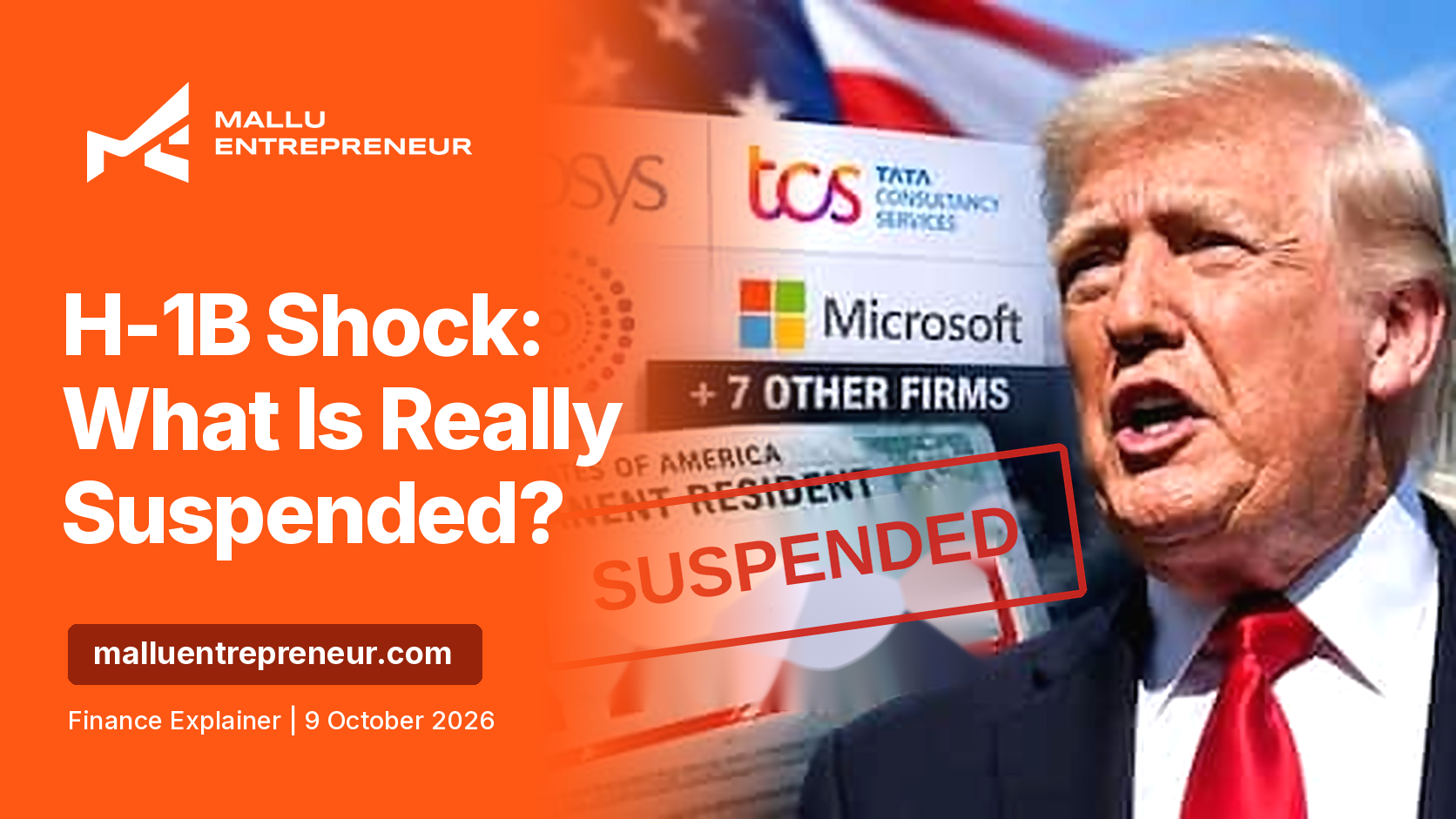
Headlines say "US suspends H-1B". That is not what happened. On 8 October 2026 the US suspended eight companies from the green card process, not the H-1B visa itself. Here is exactly what is real today, and what it means for Indian IT.
What actually happened
On 8 October, Vice President JD Vance and Labor Secretary Keith Sonderling announced that the Labor Department is suspending Microsoft, Adobe, Cognizant, Infosys, Tata (TCS), Wipro, HCLTech and Capgemini from the Permanent Labor Certification Programme, called PERM. The Labor Department will not accept new PERM applications from them or process pending ones. The reason given is alleged abuse of the system, and Sonderling said there are multiple federal investigations under way. Vance said the suspension is indefinite.
PERM is the first step to a green card for a worker an employer sponsors. It is not the H-1B visa. Reports say existing H-1B workers keep their status and their right to work. We could not find a written Labor Department notice or press release yet, so everything here is from the officials' public statements as reported by Bloomberg, Politico, Economic Times and India Today. One US outlet wrote that the government will not process new or pending H-1B applications for these firms. Most other reports say H-1B is untouched. Treat that point as unconfirmed until a written notice appears.
What is not happening
There is no blanket H-1B suspension. The $100,000 fee on new H-1B petitions exists under a presidential proclamation that the White House extended on 18 September 2026 until September 2027. But federal courts have blocked how it is collected: a Massachusetts court in June (USCIS says it is complying while it appeals) and a California court on 30 September. The proclamation itself still stands, and collection could restart if the rulings change. USCIS also added a 9-11 Biometric Fee for some employers effective 9 September 2026.
Why Indian IT is in the news
Indians got about 70 percent of the 406,348 H-1B petitions approved in FY 2025, according to USCIS data reported by the Times of India. Roughly 57,000 new H-1B visas were approved for Indians in FY 2026, down 28 percent from FY 2024 (India Today).
What it means for people already working at these firms in the US
Confirmed in the reporting:
- Current H-1B status and the right to work are not suspended. Workers at these companies keep working on their existing H-1B while the suspension lasts (Ellis law firm explainer, Politico).
- The hit is to the green card pipeline. The Labor Department will not accept new PERM applications from the eight firms and has stopped work on PERM cases already filed. So a worker whose employer has not yet filed cannot start, and a worker with a PERM case pending is stuck waiting. No end date has been set.
- That means a longer road to permanent residency. Nothing moves at the first step until the hold ends, so every later step (I-140, then the green card itself) starts late.
- H-1B extensions that depend on PERM are the next pressure point. Many H-1B workers need a PERM case on file to stay beyond the six-year H-1B limit, so a long freeze can hurt them near that limit. Workers with an approved I-140 are further along and less at risk, since USCIS handles the I-140 and the suspension only covers the Labor Department's PERM step. If an approved I-140 is waiting behind the yearly per-country limit, extensions of three years at a time are usually possible without a new PERM (Ellis).
- Many staff are already in the system. Microsoft said 80 percent of its roughly 6,000 H-1B filings last year were to extend or change the status of current employees, so many staff are already inside the system (Bloomberg).
Not confirmed:
- How long it lasts. Reports point to a possible 180-day first pause under 20 CFR 656.31, but there is no written Labor Department notice yet.
- Whether workers placed on US government contracts are affected. Reports say this is not clear yet.
- One US outlet wrote that H-1B applications for these firms are also frozen. Most other reports say H-1B is untouched.
- Exactly what happens to individual workers near their six-year limit. This depends on each case, so anyone in that position should talk to their company's immigration lawyer rather than rely on a news explainer.
Impact on the Indian IT sector
Short term: limited. The six IT services firms made fewer than 1,400 of the 117,849 PERM requests between October 2024 and September 2025, under 2 percent of the total (Mint, via India Today). Nasscom says Indian firms have cut their dependence on work visas and hired more locally in the US. Analysts quoted by Business Today call the immediate effect mostly sentiment.
Where it can bite:
- Retention. Many H-1B workers need a PERM case to stay beyond the six-year H-1B limit. A long freeze could push people to leave or switch employers. Some can extend with an approved I-140.
- Cost. More local hiring, recruiting and compliance spending, which can squeeze margins if it drags on.
- Government contracts. It is not yet clear whether workers on US government projects are affected.
- Career path. India Today quotes immigration lawyers who say firms may sponsor fewer green cards. The classic route of Indian college, IT firm, H-1B, green card gets narrower.
We do not have company-level margin or cost numbers for this suspension, and we are not guessing at them.
What to watch
A written Labor Department notice, how long the suspension lasts (reports point to a possible 180-day first pause under 20 CFR 656.31, which we could not confirm in an official text), and whether the courts or agencies change the $100,000 fee. This post reflects reporting as of 9 October 2026 and may change.
Sources
- Politico, 8 Oct 2026
- Bloomberg via Bloomberg Government
- Economic Times
- India Today, impact in numbers
- Business Today, market reaction
- Times of India, H-1B approvals
- White House, Proclamation extension
- Ellis, PERM suspension explainer (law firm, not official)
- Bloomberg via Staffing Industry Analysts, Microsoft statement
- USCIS, H-1B page