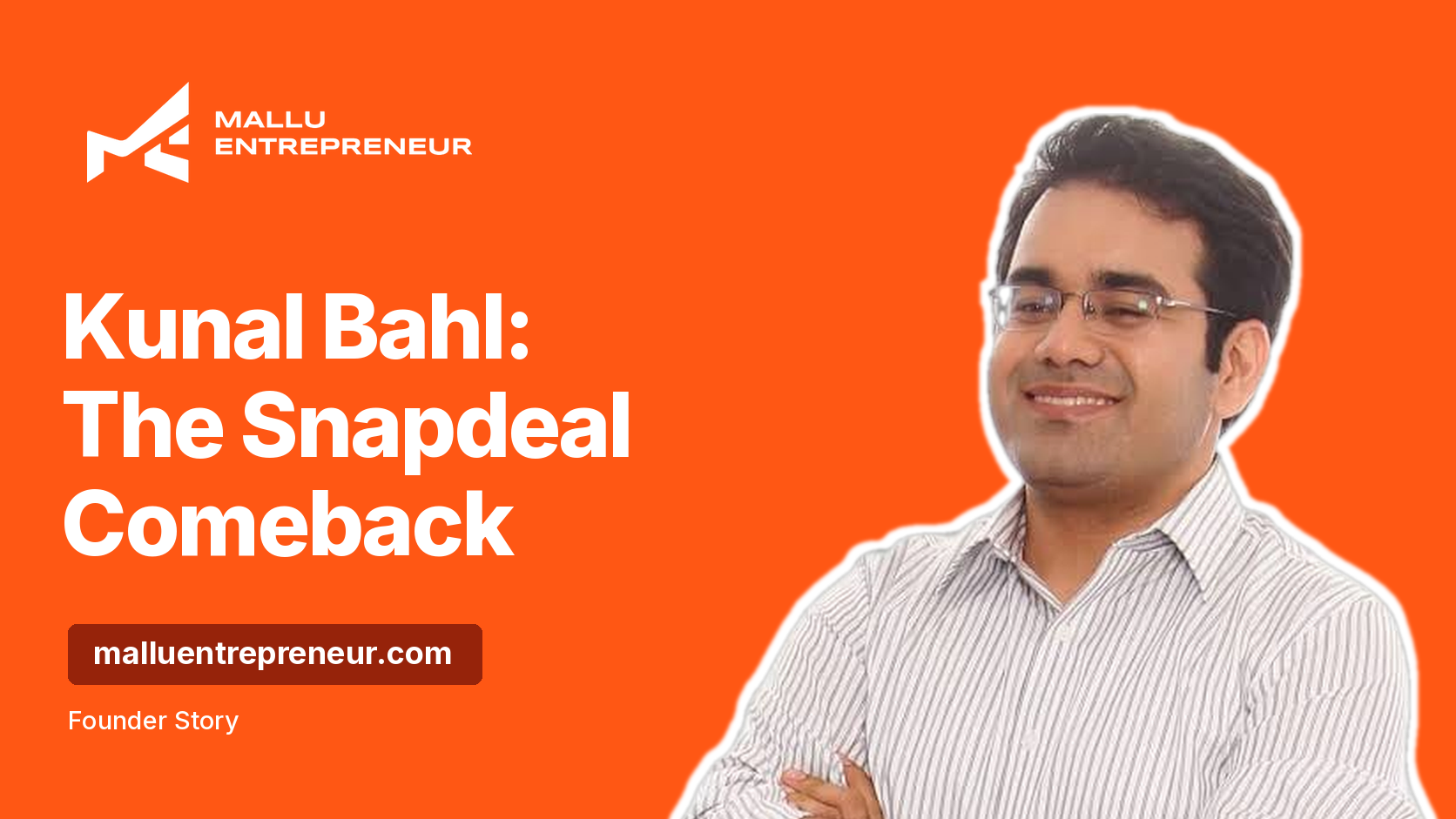
He missed his first-choice college, lost his US work visa and watched his company lose ground. Then he listed it on the stock market.
Kunal Bahl is the co-founder of Snapdeal and its parent AceVector, and of the early-stage fund Titan Capital. His story is mostly about pivots and staying power. Here is how it actually went.
The early setbacks
Bahl grew up in Delhi and studied at DPS R.K. Puram. He did not get into one of India's top colleges, then went to the University of Pennsylvania, where he earned degrees from Wharton and the engineering school. He told the Wharton Club of New York that the setback pushed him toward that path.
After graduating he worked at Microsoft, but he could not get a US work visa and returned to India in 2007.
How he actually did it
1. He started small with a friend. He and his school friend Rohit Bansal began with a coupon-book business. The first cheque was $100,000 from an angel investor, a Microsoft retiree. The investor offered $200,000, but the two asked for half because they did not know what they would do with more.
2. He pivoted again and again. Printed coupons did not work. SMS coupons did not work. A discount card did not work. In early 2010 they tried a Groupon-style daily deal site, which grew to lead that market in about eight months.
3. He changed the business when the market was limited. After visiting China and seeing Alibaba sell physical goods, they shut the coupon part and built a marketplace. In 2013 they had one month of cash left before securing $1 million. Larger rounds followed from eBay, Singapore's sovereign wealth fund and SoftBank.
4. He cut back when it was needed. A long merger effort did not work out and cash was draining. At the end of 2017 the team chose to divest non-core assets and focus. Bahl calls the result "Snapdeal 2.0".
5. He built businesses out of the company. The group created Unicommerce, a software business that listed in 2024, and Stellaro Brands, a house of brands. Bahl and Bansal also run Titan Capital, which has backed companies such as Ola, Urban Company and Mamaearth.
Where it stands now
AceVector, Snapdeal's parent, raised Rs 420 crore in an IPO that closed on September 29, 2026. It listed on October 5 at Rs 28.32 on the NSE, about 11.5% below the Rs 32 issue price, and closed that day at Rs 26.10, according to The Economic Times. Bahl and Bansal did not sell shares in the IPO. The company still reported a net loss in FY26, though reports differ on the exact figure, and Snapdeal has lost ground to larger rivals.
Five lessons for founders
- Your first idea may not be the business. Be ready to change it.
- Start with what you can fund. They took half the money they were offered.
- Look at other markets for ideas, as they did in China.
- Cut and focus when cash is tight.
- Staying alive long enough is a strategy. Bahl says, "You are not dead if you are not dead."
A fair note
A listing is not the same as success, and a weak debut shows markets are cautious. This is a founder story, not investment advice. Several quotes come from Bahl's own interviews.
Facts from the sources below.
Sources
- The most important thing for founders is to keep your head in the game: Kunal Bahl and Rohit Bansal - Forbes India, Nov 22, 2023
- Kunal Bahl, Snapdeal - Failure, Focus and Family - The Wharton Club of New York Magazine, Jan 10, 2019
- Snapdeal parent AceVector lists at 12% discount - The Economic Times, Oct 5, 2026
- Snapdeal parent AceVector makes weak Dalal Street debut - CNBC-TV18, Oct 5, 2026
- Kunal Bahl - Wikipedia