

A health policy is easy to buy and hard to judge. Two plans with the same sum insured can behave very differently on the day you claim. This guide gives you six steps and ten checks, using IRDAI rules and published data, so you can compare plans yourself before you pay.
Disclosure: this post is educational. I run AssureKart, and I earn a commission if you buy a health policy through me. That does not change the premium you pay. I am not recommending any insurer or plan here, and nothing in this post is a promise about claims or returns.
Step 1: Know who needs cover
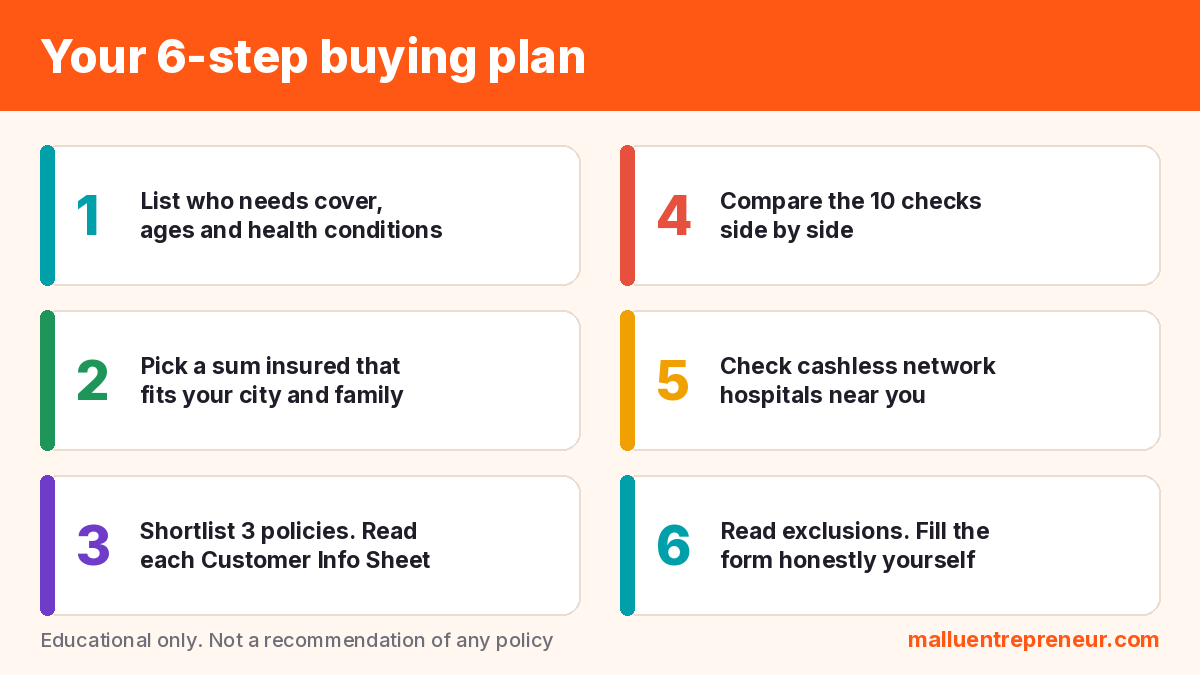
List every person you want to cover, their ages, and any existing conditions such as diabetes, blood pressure or thyroid. This decides the waiting periods that matter to you and whether a family floater or separate policies fit better. Always disclose your health history truthfully on the proposal form. Fill it in yourself and never sign a blank form, as IRDAI advises.
Step 2: Pick a sum insured
Sum insured is the most the insurer will pay in a policy year. Choose it by thinking about hospital costs in your city and who is covered, not by the lowest premium. A cheap premium with a small sum insured can leave you paying from your own pocket. Compare the premium against what you actually get, not in isolation.
Two features can stretch a sum insured. A cumulative bonus, which IRDAI defines as an increase in sum insured without an increase in premium, and a restore benefit, which refills the cover after you exhaust it. Check the conditions of each, as the terms differ between policies.
Step 3: Check the insurer's track record
Three numbers tell you whether an insurer pays and whether it can keep paying.
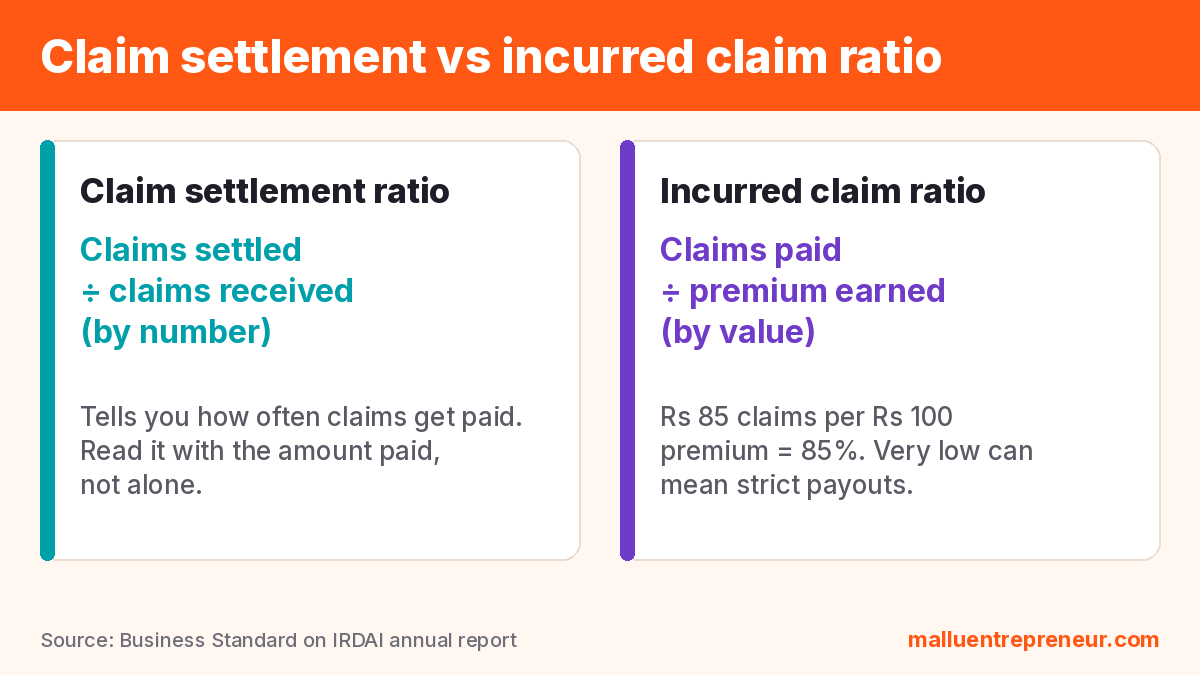
- Claim settlement ratio (CSR): claims settled divided by claims received, by number. A higher figure is generally better. But read it along with how much was paid and how many claims were repudiated, because a ratio by count hides small payouts.
- Incurred claim ratio (ICR): claims paid divided by premium earned, by value. An ICR of 85% means Rs 85 of claims for every Rs 100 of premium. Business Standard reported, citing the IRDAI annual report for 2024-25, that the non-life industry ICR was 82.88%, and that experts generally see 70 to 90% as comfortable. A very low ratio may point to tight payouts. A very high one can signal financial stress.
- Solvency ratio: available solvency margin divided by the required solvency margin, as IRDAI defines it. It shows whether the insurer holds enough capital to pay future claims. Insurers must stay above the regulatory minimum, and the figure is published in their public disclosures.
IRDAI publishes insurer-wise data in its annual report. Look at the latest year and at the trend over a few years, not one number.
Step 4: Check hospitals and how claims work
- Network hospitals: a network provider is a hospital that gives cashless treatment under your policy. Check that good hospitals near your home, and near your parents if they are covered, are on the list. IRDAI requires network hospitals to be registered in the ROHINI registry.
- Cashless speed: IRDAI's 2024 master circular says insurers should decide cashless requests within one hour and give final authorization within three hours of the hospital's discharge request.
- Claim rejections: under the same circular, no claim can be repudiated without the approval of the insurer's Claims Review Committee.
Step 5: Read the fine print
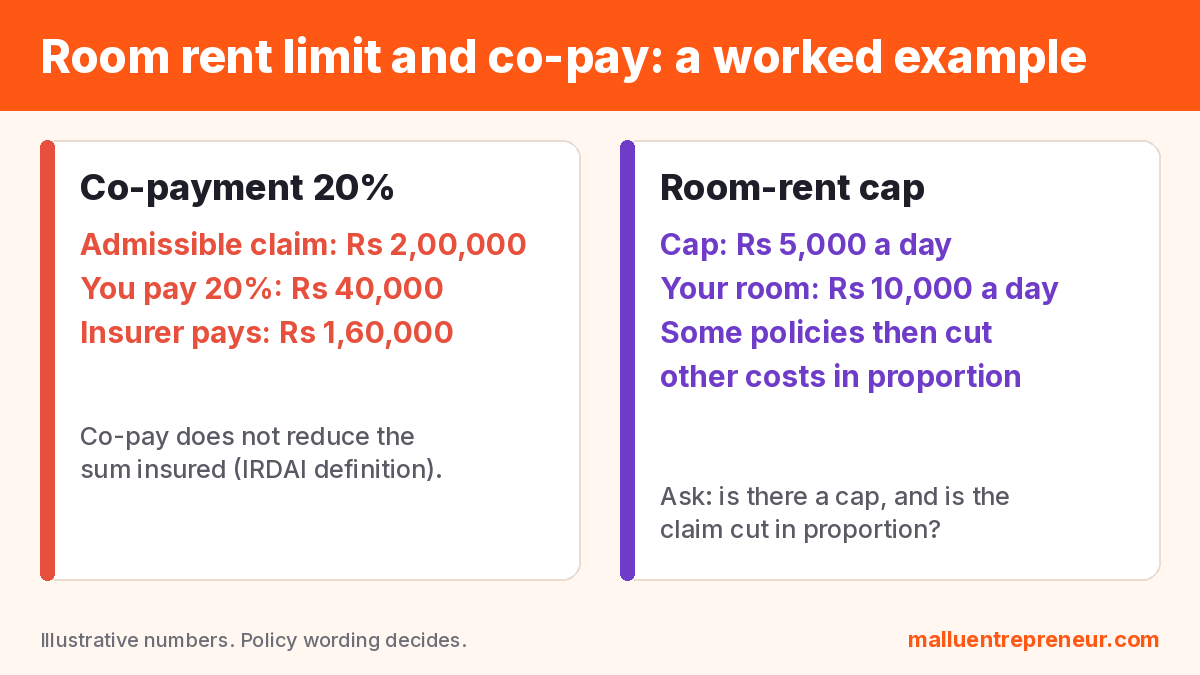
- Room-rent limit: some policies cap the room rent per day. If your room costs more than the cap, some insurers reduce other charges in proportion. Ask if the plan has a cap and how the claim is cut if you cross it.
- Co-payment: IRDAI defines it as a cost-sharing requirement where you bear a set percentage of the admissible claim. It does not reduce your sum insured. With a 20% co-pay on a Rs 2,00,000 claim, you pay Rs 40,000 (illustration).
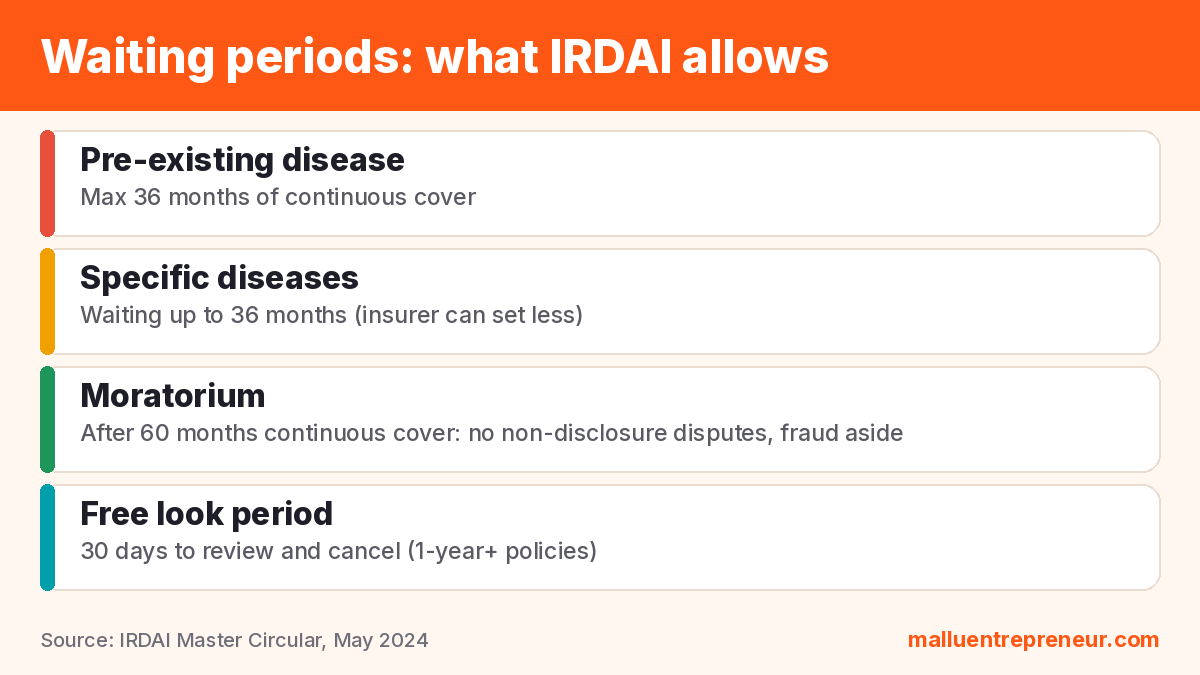
- Waiting periods: under IRDAI's 2024 master circular, the waiting period for pre-existing diseases you disclosed is a maximum of 36 months of continuous cover, and specific-disease waiting is also capped at 36 months. Insurers may offer less. Lower is better for you.
- Moratorium: after 60 months of continuous cover, a claim cannot be contested for non-disclosure or misrepresentation, except for established fraud.
- Exclusions: read the list of what is not covered. The Customer Information Sheet that comes with every policy summarizes the exclusions, sub-limits, deductibles and waiting periods in simple words.
Step 6: Compare side by side, then buy
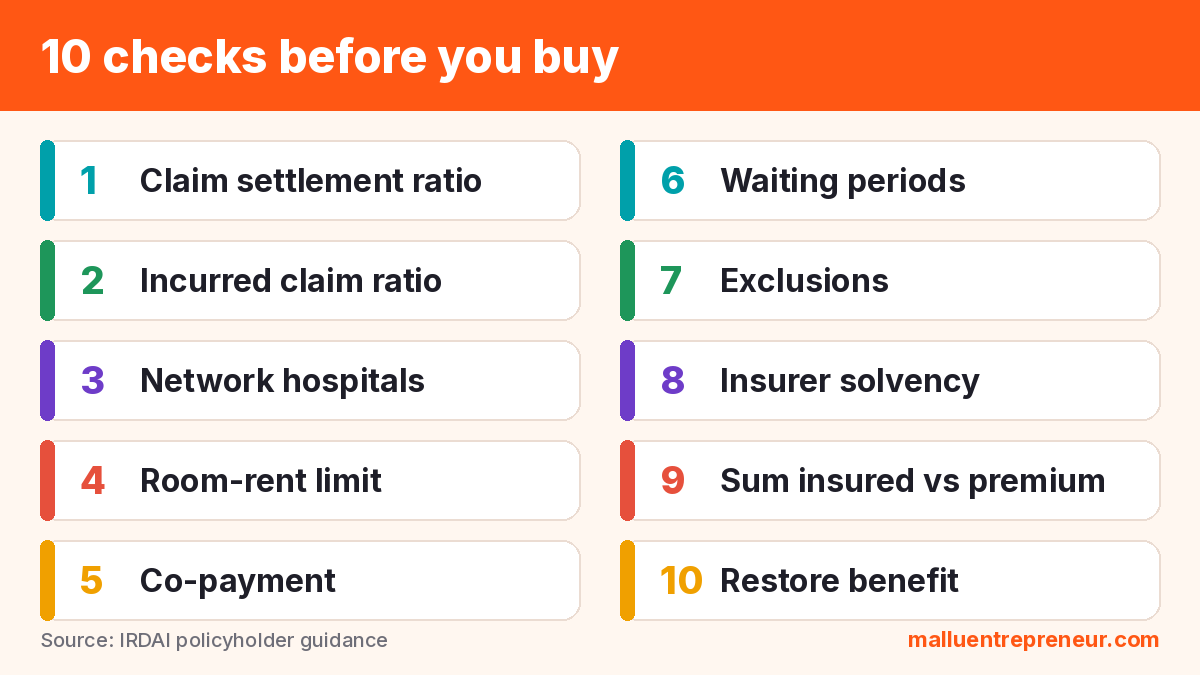
Put your two or three shortlisted plans in a table against the ten checks: claim settlement ratio, incurred claim ratio, network hospitals, room-rent limit, co-pay, waiting periods, exclusions, insurer solvency, sum insured against premium, and restore benefit. A plan that wins on premium but loses on room rent, co-pay and waiting periods is rarely the cheaper plan in the end.
After you buy, you get a free-look period of 30 days from receiving the policy document to review the terms and cancel if you disagree (for policies of one year or more). Your policy is renewable, and an insurer cannot deny renewal just because you made a claim. If you switch insurers later, IRDAI rules let you carry over credits such as waiting periods and no-claim bonus through portability.
Want a second opinion before you buy?
If you want someone to look at your shortlist, fill in the short form below. It asks about who you want to cover, their ages and your priorities, so a second opinion can match your situation.
Get a free second opinion on your insurance
As noted above, I earn a commission if you buy a policy through me. You are free to compare and buy anywhere. The form collects health details, so share only what you are comfortable with.
Quick checklist
- Cover list and honest health history
- Sum insured that fits your city and family
- CSR, ICR and solvency of the insurer
- Cashless hospitals near you
- Room-rent cap and co-pay
- Waiting periods and exclusions
- Restore benefit and cumulative bonus conditions
- Free-look period after buying
This post is general education, not insurance advice or a recommendation of any insurer or plan. Terms differ by policy, so read the policy wording and Customer Information Sheet before you buy.
Sources
- IRDAI Master Circular on Health Insurance Business (29 May 2024), summarized at TaxGuru: https://taxguru.in/corporate-law/master-circular-irdai-insurance-productsregulations-2024health-insurance.html
- IRDAI Master Circular on Standardization of Health Insurance Products (definitions of co-payment, room rent, cumulative bonus, network provider): https://irdai.gov.in/documents/37343/366029/Master+Circular+on+Standardization+of+Health+Insurance+Products.pdf/40548736-71a8-1b76-e28d-0df899407e1e?download=true&t=1665033878433&version=1.2
- IRDAI Policyholder portal, How to Buy Health Insurance and From Whom: https://irdai.gov.in/en/web/policy-holder/how-to-buy-health-insurance-and-from-whom
- IRDAI definition of solvency ratio: https://irdai.gov.in/en/document-detail?documentId=398837
- Business Standard on IRDAI 2024-25 incurred claim ratios (1 Jan 2026): https://www.business-standard.com/finance/personal-finance/paying-claims-or-pushing-back-what-irdai-data-reveals-about-insurers-126010100580_1.html
- Business Today on the 36-month and 60-month changes (12 Apr 2024): https://www.businesstoday.in/personal-finance/insurance/story/irdai-reduces-pre-existing-disease-waiting-period-from-4-to-3-years-here-is-what-existing-policyholders-should-know-425325-2024-04-12



.png)