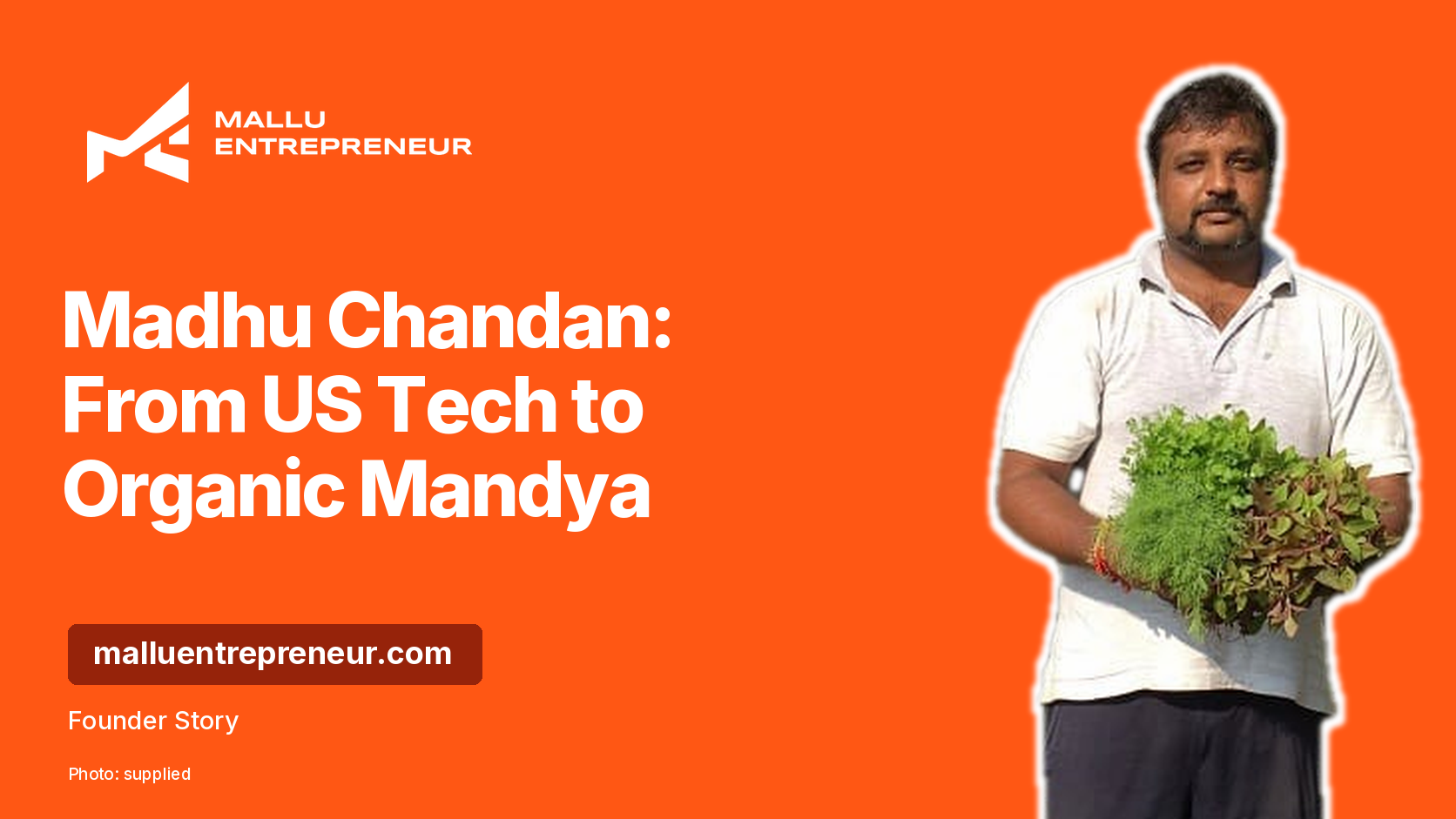
He had a software company in San Jose. He came home to Mandya and started with one acre.
Madhu Chandan's story is not about quitting a job to "find himself". It is about a specific problem he saw, and the slow, unglamorous way he fixed it.
The tech career
Madhu studied electronics and communication engineering at PET Engineering College, University of Mysore. He started at RelQ Software in Bengaluru in 2000, moved to the UK in 2002 and worked in several countries as an automation engineer. In 2005 he co-founded Verifaya Corporation in San Jose, which built a testing tool for software applications.
By his own account, he was earning well and had the life he wanted.
The thing he could not ignore
Madhu's family comes from an agricultural background in Mandya district, Karnataka. On visits to Bengaluru for Verifaya's R&D office, he noticed that many auto drivers and service workers were children of farmers from Mandya. They had left because they saw no hope in farming.
Around the time he decided to return, Mandya was reported as the district with the highest number of farmer suicides in Karnataka in 2015. He told The Weekend Leader he felt he had to do something for the people of his district.
His wife Archana backed the decision. He moved back to India in 2014.
How he actually did it
1. He started with one acre. "Initially nobody believed me," he said. He farmed one acre organically to show the results instead of arguing.
2. He did not ask farmers to switch overnight. A couple of early switchers failed badly. So he asked farmers to convert land bit by bit. Soil that has seen years of chemicals needs about two to three years to change.
3. He built a co-operative. In 2014 he founded the Mandya Organic Farmers Cooperative Society.
4. He fixed the market, not only the farm. Organic produce is no use if farmers cannot sell it at a better price. In 2015 he opened the first Organic Mandya store on the Bengaluru-Mysuru highway, with about Rs 1 crore borrowed from friends, and paid farmers a premium over normal prices.
5. He added processing. A 10,000 sq ft warehouse turns farm produce into products such as ghee, butter, jaggery powder, cold-pressed coconut oil and Rajmudi rice.
What it became
As of July 2021, The Weekend Leader reported eight Organic Mandya stores (six in Bengaluru, two on the highway), more than Rs 25 crore turnover in the previous financial year, and about 1,200 farmers in the co-operative. About 60 people worked in the warehouse and 60 in the stores. These are the latest figures we found and may be out of date.
The company's website lists two co-founders alongside Madhu: Bhaskara Kempaiah as CTO and Sahana Hegde as COO. It also says the central government nominated Madhu to the management committee of ICAR and appointed him Karnataka's representative on the Coconut Development Board.
What founders can take from this
- He started with a problem he knew first-hand, not a trend.
- He proved it small before asking others to follow.
- He solved both ends: supply (farmers) and demand (stores). Fixing only one would have left the other broken.
- He accepted that the premium price meant a smaller customer base, and built for people who would pay it.
- Slow conversion beat a dramatic switch.
A fair note
Organic farming often has lower yields, which Madhu himself acknowledged. The model works only because buyers pay a higher price. This is one founder's account, mostly from interviews and the company's own site, not an independent audit.
Photo supplied. Facts from the sources below.
Sources
- US-returned software engineer promotes organic farming and builds a Rs 25 crore turnover retail chain - The Weekend Leader, July 24, 2021
- Madhuchandan, a software engineer from US is making farmers richer! - Rediff.com, Nov 18, 2015
- Meet Our Team - Organic Mandya