Petrol pumps look the same today. The bill has not gone away.
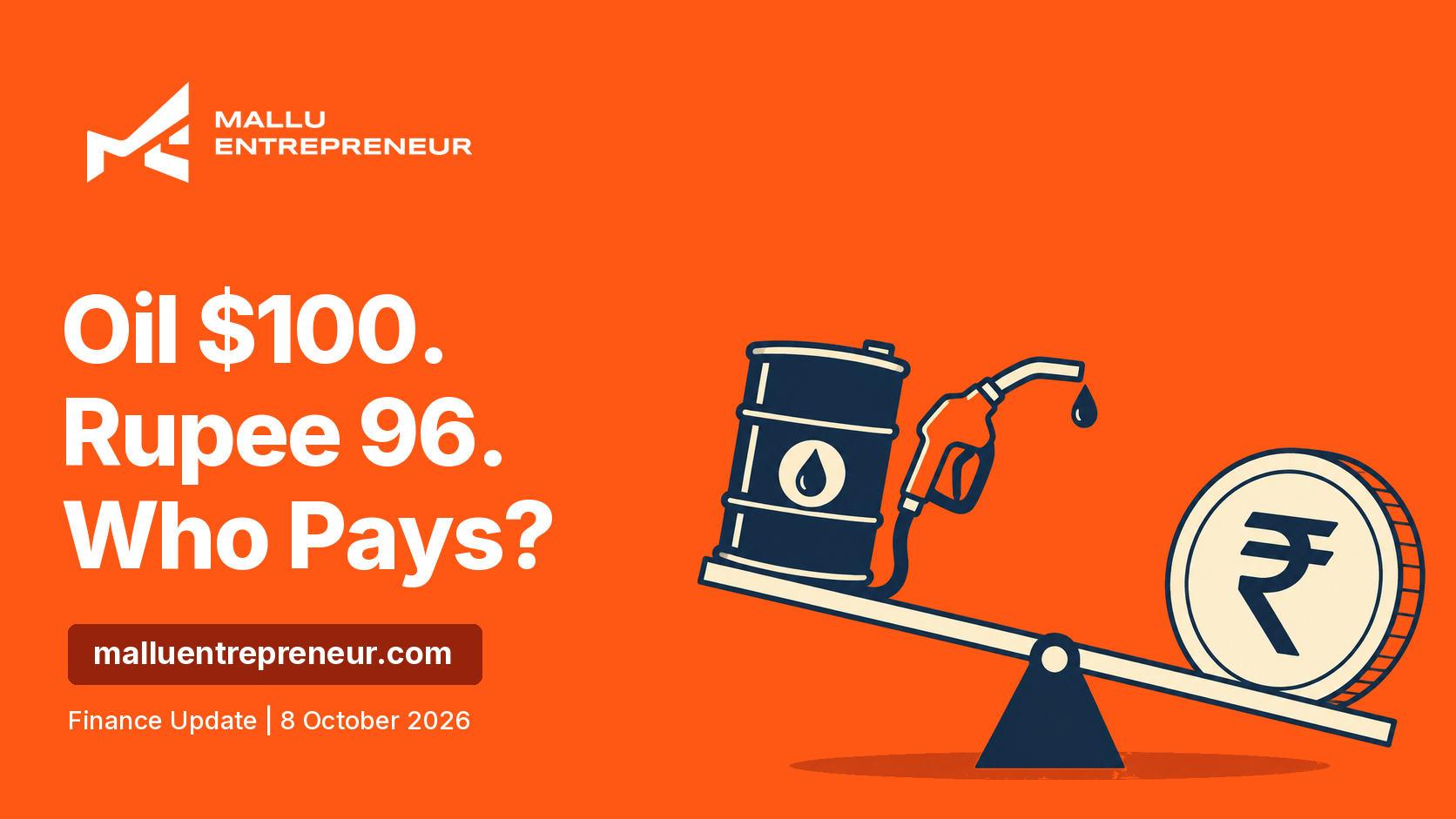
India buys more than 85% of its crude oil from abroad, and it pays in dollars. So when oil gets pricier and the rupee gets weaker at the same time, the country is hit twice.
What is happening?
Brent crude has traded near or above $100 a barrel for almost a month, according to a Moody's Ratings note reported by The Hindu BusinessLine on October 7. The rupee was trading around 96.78 to the dollar on the afternoon of October 7, with an intraday low of 96.85, even after the RBI raised rates that day.
India's own crude basket, which the government's PPAC tracks, averaged $82 a barrel in July, $90.2 in August and $116.1 in September.
Why a weak rupee makes oil costlier
Oil is bought in dollars. If the rupee falls, every barrel needs more rupees even when the dollar price does not move.
Illustration with made-up round numbers: a $100 barrel at Rs 90 per dollar costs Rs 9,000. At Rs 96 per dollar, the same barrel costs Rs 9,600. That is Rs 600 more, about 6.7%, with no change in the oil price.
Now add a higher oil price on top. That is the double squeeze.
So why has petrol not become costlier?
Retail petrol and diesel prices have reportedly been unchanged since May 2026. Pump prices are set by oil marketing companies (OMCs) and the government, not by the daily crude price.
That does not mean the cost disappears. Someone absorbs it. There are only three candidates:
- You, if retail prices are raised.
- The OMCs, if they keep prices frozen and accept thinner margins or losses.
- The government, if it recapitalises the OMCs or cuts taxes, which then costs the budget.
Analysts quoted by The Hindu BusinessLine say this choice may have to be made at some point if crude stays high. Moody's expects the 2026 baseline crude price to be in the $90 to $110 range, assuming the West Asia conflict eases by late 2026. No price hike has been announced.
Where else could you feel it?
Fuel is not the only route. Many components, raw materials, machines and electronics are imported and priced in dollars. A weaker rupee can raise costs for phones, TVs and ACs, and for businesses that import inputs.
The RBI has already raised its FY2026-27 inflation forecast to 5.2%, partly because it now assumes oil at $95 a barrel in the second half of the year, up from $85. India's petroleum imports rose 21.3% year on year to $35 billion in July-August 2026.
What can you do?
- If your business buys imported parts or ships goods, check how much of your cost is dollar-linked.
- Watch for price notices from suppliers over the next few weeks. They may pass on the rupee move.
- Avoid planning your budget on today's fuel price staying fixed forever. It may or may not change.
The bottom line
Today's fuel price hides the cost, but it does not remove it. The real question is who pays, and when. The answer depends on oil, the rupee and policy decisions that have not been made yet.
Educational information, not financial advice. The barrel example uses made-up round numbers. Figures are from the sources below, dated October 2 to October 7, 2026.
Sources
- Retail prices of diesel and petrol will have to be raised at some point: Moody's Ratings - The Hindu BusinessLine, Oct 7, 2026
- RBI Policy: Complex oil math explains rise in FY27 inflation estimates - The Economic Times (PTI), Oct 7, 2026
- Rupee weakens despite RBI rate hike - Indian Economic Observer, Oct 7, 2026
- Why $100 Oil and a 96-Rupee Dollar Matter to Every Indian - RTV English, Oct 2, 2026
- Our post on the RBI rate hike