
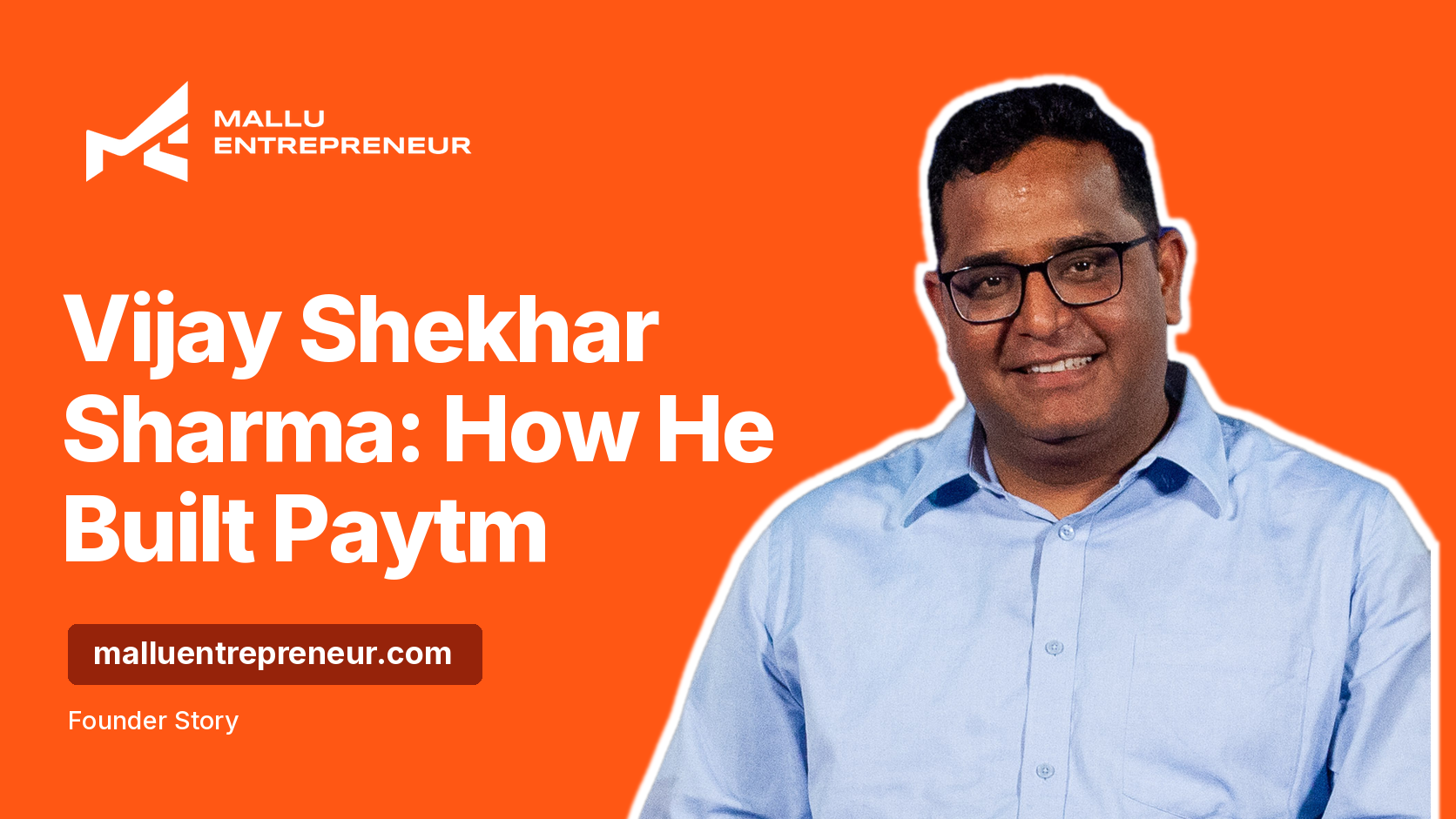
Photo: Vijay Shekhar Sharma at the Horasis India Meeting, 2019. Photo by Frank-Jürgen Richter, licensed CC BY-SA 2.0 via Wikimedia Commons. Cropped, with the background removed for the banner.
At 27, Vijay Shekhar Sharma earned Rs 10,000 a month, and his father asked him to shut his company and take a job. A decade later he was one of India's youngest billionaires and led the country's biggest IPO at the time. This is the Vijay Shekhar Sharma story: how the founder of Paytm turned a small-town start into a company that changed how India pays, and what young founders can learn from it.
Who is Vijay Shekhar Sharma?
Vijay Shekhar Sharma is the founder and CEO of Paytm, one of India's best-known digital payments brands. He was born in Uttar Pradesh to a school teacher father and a homemaker mother, and comes from the Aligarh area (Reuters, Economic Times). Forbes lists his wealth as self-made and describes him as the son of a schoolteacher from a small city in north India.
The English problem that nearly broke him
Sharma was a school topper. Then he reached an engineering college where classes were in English. In 2025 he told the Netflix show The Great Indian Kapil Show that he was not fluent in English, felt humiliated when he could not answer in class, slid from the front bench to the back and had to write supplementary exams (Economic Times). His takeaway: people should chase their goals in the language they are comfortable with.
Early struggles: an "ineligible bachelor"
After college he started a small company selling mobile content. By 27 he was making Rs 10,000 a month. "In 2004-05, my father asked me to shut my company and take up a job even if it was for 30,000 rupees," he told Reuters. He joked that his income made him an "ineligible bachelor" for prospective families.
How Paytm took off
- It started small. Paytm began just over a decade before its IPO as a mobile recharge company, according to Reuters.
- It rode a partner's growth. It grew quickly after ride-hailing firm Uber listed it as a quick payment option in India.
- A national shock helped. India's 2016 ban on high-value currency notes pushed many people toward digital payments. Forbes calls Paytm one of the biggest beneficiaries.
- Big investors came in. China's Ant Group first invested in 2015. In August 2018, Warren Buffett's Berkshire Hathaway invested $300 million (Forbes). Sharma became India's youngest billionaire in 2017 (Reuters).
- It faced a crowd of rivals. When Google, Amazon, WhatsApp and PhonePe entered payments, Sharma asked SoftBank's Masayoshi Son for advice. Son told him to "raise more money, double down and go all in" on payments (Reuters).
The hard chapters: IPO fall and an RBI crackdown
In November 2021 Paytm led India's largest IPO ever, about $2.5 billion. On debut its shares fell more than 27%, wiping over $5 billion off its IPO valuation, one of the worst major Indian stock debuts (Reuters).
In January 2024 the Reserve Bank of India ordered Paytm Payments Bank to stop accepting fresh deposits and credit transactions after February 29, after what it called persistent non-compliance. Sharma held 51% of the bank, and Paytm's listed company held 49% (Reuters). In February 2024 Sharma stepped down from the payments bank board (Reuters).
Where Paytm is now
Paytm reported its Q1 FY27 results (quarter ending June 2026) on July 20, 2026: operating revenue of Rs 2,448 crore, up 28% from a year earlier, and profit after tax of Rs 220 crore, up 79%. It also reported its highest ever quarterly EBITDA of Rs 203 crore (Paytm earnings release). Forbes lists Sharma's net worth at $1.6 billion as of October 2, 2026.
5 lessons for young founders from Vijay Shekhar Sharma
- Your starting language or background is not a ceiling. He struggled with English, and still built a national brand.
- Pressure to quit is normal. His family asked him to take a job. He kept building and learned from each small business.
- Start with a simple, frequent need. Paytm began with mobile recharges, something people did every month, then expanded.
- Ride the right partners and moments. Uber's listing and the 2016 shift to digital payments pushed growth. Be ready when a wave arrives.
- Setbacks are not the end of the story. A weak IPO debut and a regulatory crackdown hit hard. Paytm's most recent quarter shows a profit.
Sources
- Reuters via Times of India, Paytm's Vijay Shekhar Sharma: From 'ineligible' bachelor to billionaire (November 18, 2021)
- Reuters, Paytm sinks on debut as India's biggest IPO irks some investors (November 18, 2021)
- Reuters, Indian cenbank restricts Paytm Payments Bank deposits, credit transactions (February 1, 2024)
- Reuters, Paytm's Vijay Shekhar Sharma quits payments bank board (February 26, 2024)
- Forbes, Vijay Shekhar Sharma (profile)
- The Economic Times, Paytm founder Vijay Shekhar Sharma reveals how he went from school topper to 'backbencher' in college (August 24, 2025)
- Paytm, Q1 FY27 results (July 2026)
Building your own startup idea? Book a one-to-one Clarity Call with Mallu Entrepreneur



